
Lake County Parole Versus Probation
Parole and probation can both involve reporting rules, an assigned agent, and conditions. Their legal source is different. The Michigan Parole Board grants parole after an MDOC prison term. The person has left prison but remains under MDOC jurisdiction. A Lake County court imposes probation and keeps jurisdiction over that sentence. Someone listed as a probationer may never have served a prison term, so that status cannot establish when a person left the Lake County Jail.
| Point | Parole | Probation |
|---|---|---|
| How it begins | Michigan Parole Board grants supervised release from prison | A court orders supervision as part of a sentence |
| Public OTIS status | Parolee | Probationer |
| What it proves | The person left MDOC prison for supervision | The person is under a probation order, not necessarily that prison custody occurred |
| Legal jurisdiction | MDOC and the Michigan Parole Board | The sentencing court, with MDOC field supervision where assigned |
| End point | Parole discharge or maximum discharge | Discharge or expiration under the court order |
The labels must be read with the sentence record. An inactive sentence does not prove that every MDOC matter has ended, especially when several sentences appear. “Discharged” means MDOC jurisdiction shown for the sentence has ended. That date may be much later than the date the person left prison on parole.
- Parole
- Community supervision that follows release from an MDOC prison.
- Probation
- Court-ordered supervision that may occur without a prison term.
- Discharge
- The end of the stated MDOC jurisdiction or supervision term.
- Absconder
- A person reported as failing to remain in contact with the authority responsible for supervision.
Verify Lake County Post-Release Supervision
The public starting point is the Michigan Department of Corrections OTIS service. OTIS covers active MDOC prisoners, parolees, probationers, and people within its public post-discharge window. It does not cover a Lake County jail-only sentence. Use the MDOC number when known because MDOC treats it as a unique key. Otherwise, search by name and compare the date of birth, aliases, SID number, county, court file, and physical details.
- Accept the OTIS terms and open the search form. Choose “All” if the present status is uncertain.
- Enter the MDOC number when available. For a name search, enter at least the last name and refine only as needed.
- Open the matching profile. Confirm identity before relying on a parolee, probationer, discharged, or absconder label.
- Read “Current Status,” “Assigned Location,” active and inactive sentences, dates, and listed supervision conditions together.
- Contact the assigned office when the profile is unclear or a recent court action may not yet appear.
A no-match result is not proof that no supervision exists. The spelling may differ, the matter may be jail-only, the person may have aged out of the public OTIS window, or a public-access limit may apply. For the broader custody history, the Lake County released inmate search and records path separates county, MDOC, federal, and ICE records.
Important: A live jail answer establishes current physical custody only. OTIS and the assigned office are the better sources for Michigan post-release supervision.
Lake County Supervision Office Detail
Lake County has one combined MDOC parole and probation office in Baldwin. It sits at the same street address as county corrections, but it is a state supervision unit with its own phone. That distinction matters. Questions about an MDOC agent, parole condition, probation status, or OTIS supervision entry belong with the state office. Questions about a county jail booking or physical release timestamp belong with the sheriff.
Lake County Parole/Probation Office
Michigan Department of Corrections, Region 4a
1153 Michigan Avenue
Baldwin, MI 49304
(231) 745-0290
Region 4a Operations Office
301 W. Upton Avenue
Reed City, MI
(231) 832-6179
Regional contact for MDOC field operations.
The official directory should be checked before relying on an older address or assignment. A profile’s assigned location can be a supervision office, prison, or other MDOC unit. Read it with “Current Status” rather than treating the location field as proof of custody.
The MDOC Region 4 directory shows the local office context.
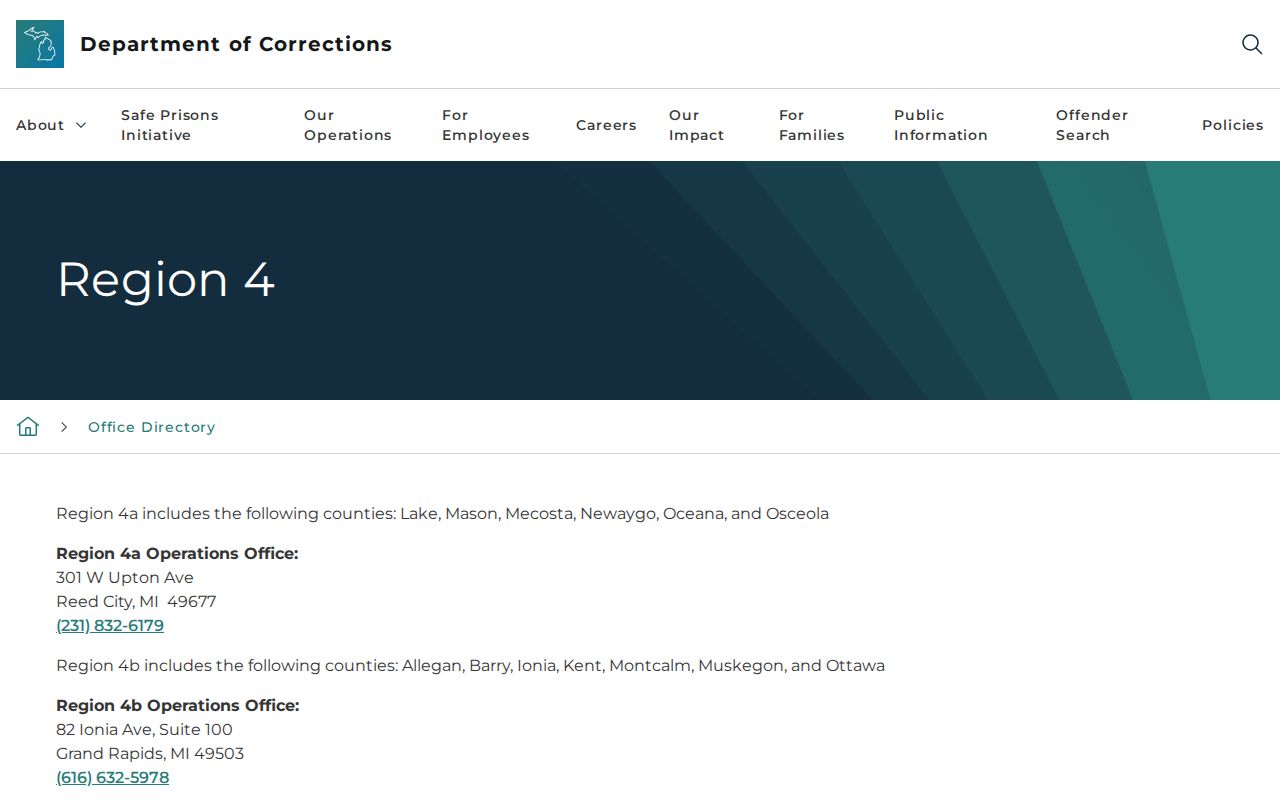
The directory view connects a Lake County supervision status to the correct state field office instead of the county jail’s main line.
Note: Confirm the assigned office in OTIS first because supervision responsibility can move while an older directory entry remains online.
Lake County Reentry Is Not Discharge
MDOC materials identify a Lake County Residential Reentry Program in Baldwin serving both men and women. A residential reentry placement is a structured MDOC setting or placement, not proof of unrestricted release. The person may still be under parole authority, live under program rules, and report to an assigned unit. The nearby Lake County Jail and North Lake Processing Center use different custody systems, so a Baldwin address alone cannot identify the person’s legal status.
Check OTIS for the exact current status and assigned location. Then confirm the placement through MDOC if the distinction matters. “Parolee at a residential reentry placement,” “released to the community,” and “discharged from MDOC” are three separate statements. The record should support the one used.
Reentry programs can form part of release planning, yet they do not erase supervision. The status remains in force until the proper authority changes it. This local distinction prevents a residential placement from being mistaken for final completion of the sentence.
Lake County Absconder Status
OTIS provides separate “Parole Absconders” and “Probation Absconders” search filters. The split reflects who holds jurisdiction. MDOC actively seeks a parole absconder because parole follows an MDOC prison sentence. A probation absconder remains under the sentencing county’s jurisdiction. Neither label should be rewritten as a new conviction. Record the exact live status, the source, and the date checked.
When a supervision status is urgent, use the assigned office or the MDOC Absconder/Escapee Tip Line at (517) 755-0855. Do not try to resolve the label through MI-VINE. MI-VINE reports participating custody and case events, while OTIS and the supervising authority carry the supervision record.
A warrant, detainer, or violation may change the next custody step. It does not by itself establish that the person is back in the Lake County Jail. Confirm the holding agency before describing the person as detained. If the OTIS label conflicts with a court record or agent information, preserve the conflict and send it to the office that can correct that field.
Status limit: An absconder entry identifies a reported supervision problem. It is not a substitute for a court disposition or current custody confirmation.
Correct Lake County Supervision Records
Responsibility for an OTIS correction depends on the source of the disputed fact. A court-originating error, such as a sentence term or disposition, should be taken to the sentencing court. A supervision error, including an absconder status that the person believes is wrong, belongs with the assigned parole or probation office. MDOC updates its public record after the court or agent supplies the required direction.
Gather the MDOC number, court file number, exact field, and a copy of the source record before contacting either office. This keeps a name-match problem from becoming a record-change request for the wrong person. It also separates a stale public display from an error in the underlying judgment.
The correction route does not change the original authority. Lake County court staff address court-created data. MDOC staff address supervision-created data. A phone statement may help locate the problem, but the written order, agent action, or updated OTIS entry is the stronger record.
Note: Save the date and wording of the disputed OTIS field so the responsible office can identify the exact entry.
Lake County Parole Decisions
The Michigan Parole Board is the sole paroling authority for MDOC felony prisoners. Its process generally begins before eligibility and considers the interview, guideline information, offense and history, conduct in prison, program work, and relevant victim information. A Board grant starts release processing. It is not the same as a physical release date, and adverse information may suspend the grant before departure.
Michigan does not publish a full public calendar of routine parole interviews. The public registration page concerns public lifer and clemency matters, while quarterly legislative reports are aggregate rather than named-person decisions. For one Lake County person, OTIS is the practical public status source. The Board or MDOC FOIA is the route for the action document.
The Michigan Parole Board information page explains the Board’s role.
The Board view helps separate parole eligibility and decision making from the local office’s day-to-day supervision work.
Lake County Supervision Discharge
Supervision ends through the authority that imposed or retained it. For parole, MDOC may record a discharge after successful completion, maximum discharge, or another sentence-specific reason. For probation, the sentencing court’s order and the MDOC profile must be read together. An OTIS “Discharged” status means MDOC jurisdiction shown for the sentence ended, but the sentence-level discharge reason must still be checked.
The final supervision date can differ from the prison exit date by years. “Date Paroled” is the more direct field for leaving prison on parole. “Discharge Date” answers when MDOC jurisdiction ended. If an inquiry is really about the future prison exit, the Lake County projected release date process explains the separate eligibility and maximum-date fields.
OTIS retains public discharged profiles for a limited period measured from supervision discharge. When a past profile no longer appears, use the sentencing court and MDOC records routes. The absence of a public result does not erase the prior supervision record.
Note: Date Paroled marks prison exit on parole, while Discharge Date marks the later end of the displayed MDOC jurisdiction.