
Lake County Projected Versus Actual Release
A projected date is a computation or eligibility point based on a sentence record. An actual release is the event when the custodial agency records that the person left its physical control or transferred to another agency. Those events can be far apart. For an MDOC prisoner, the public OTIS labels are “Earliest Release Date” and “Maximum Discharge Date.” The first is also described as the Parole Board Jurisdiction Date. It is not an appointment to leave prison.
A Lake County pretrial detainee has no sentence-based release date. Bond may be posted, a court may change the order, or another hold may remain. Even after a court authorizes release, staff must finish checks and processing. For a sentenced jail inmate, the judgment and custody ledger supply the starting facts. For a state prisoner, MDOC computes the displayed dates under Michigan law.
Scheduled versus actual: An eligibility or maximum date describes the sentence calculation. Only the custody record confirms physical release or transfer.
A transfer is not community release. A county detainer, federal writ, parole matter, or ICE detainer can move a person directly into another agency’s custody. The Lake County release record should identify a receiving agency when that information is recorded.
Find a Lake County Projected Date
Begin with the last known custodial setting. OTIS does not calculate Lake County jail-only sentences, and the jail does not control an MDOC prison term. A North Lake immigration detention matter is also outside both of those sentence systems. The Lake County released inmate records path can identify the correct source when the custodian is uncertain.
- Identify whether the person is pretrial, serving a county sentence, or serving an MDOC sentence. Use the case number and court record when possible.
- For an MDOC prisoner, open OTIS, accept the terms, and search by MDOC number or carefully matched name.
- Read “Current Status,” “Earliest Release Date,” and “Maximum Discharge Date” exactly as labeled. Check all active and inactive sentences.
- For a Lake County sentence, obtain the written judgment, sentence credit, and jail custody calculation from the court and Lake County Jail.
- Ask about every hold or consecutive sentence. Confirm the result with MDOC, the sentencing court, or the jail before relying on it.
An MDOC number is the strongest public search key because it is unique in OTIS. A name search requires identity checks such as date of birth, SID number, aliases, county of conviction, and court file. A wrong match can attach another person’s dates to the inquiry.
Note: A no-match OTIS search may reflect a jail-only case, spelling issue, older discharge, public-access limit, or system delay.
Lake County OTIS Release Fields
OTIS uses date fields for different legal events. “Earliest Release Date” marks the earliest point when the Michigan Parole Board may obtain jurisdiction, based on the minimum and any credits that lawfully apply. “Maximum Discharge Date” is the outside MDOC date shown for the sentence computation. “Date Paroled” records a prison exit into parole when parole occurred. A later “Discharge Date” identifies the end of MDOC jurisdiction shown for the sentence.
| OTIS field | What it means | What it does not prove |
|---|---|---|
| Current Status | Prisoner, parolee, probationer, discharged, or another MDOC label | The exact Lake County jail release time |
| Earliest Release Date | Parole Board jurisdiction or minimum eligibility point | A guaranteed prison departure |
| Maximum Discharge Date | Outside MDOC date displayed under the current computation | That no other agency can hold the person |
| Date Paroled | Date of prison departure or conferral of parole status | Final discharge from supervision |
| Discharge Date | End of the stated MDOC jurisdiction | That the person returned to the community on that date |
The OTIS glossary is the source for these labels.
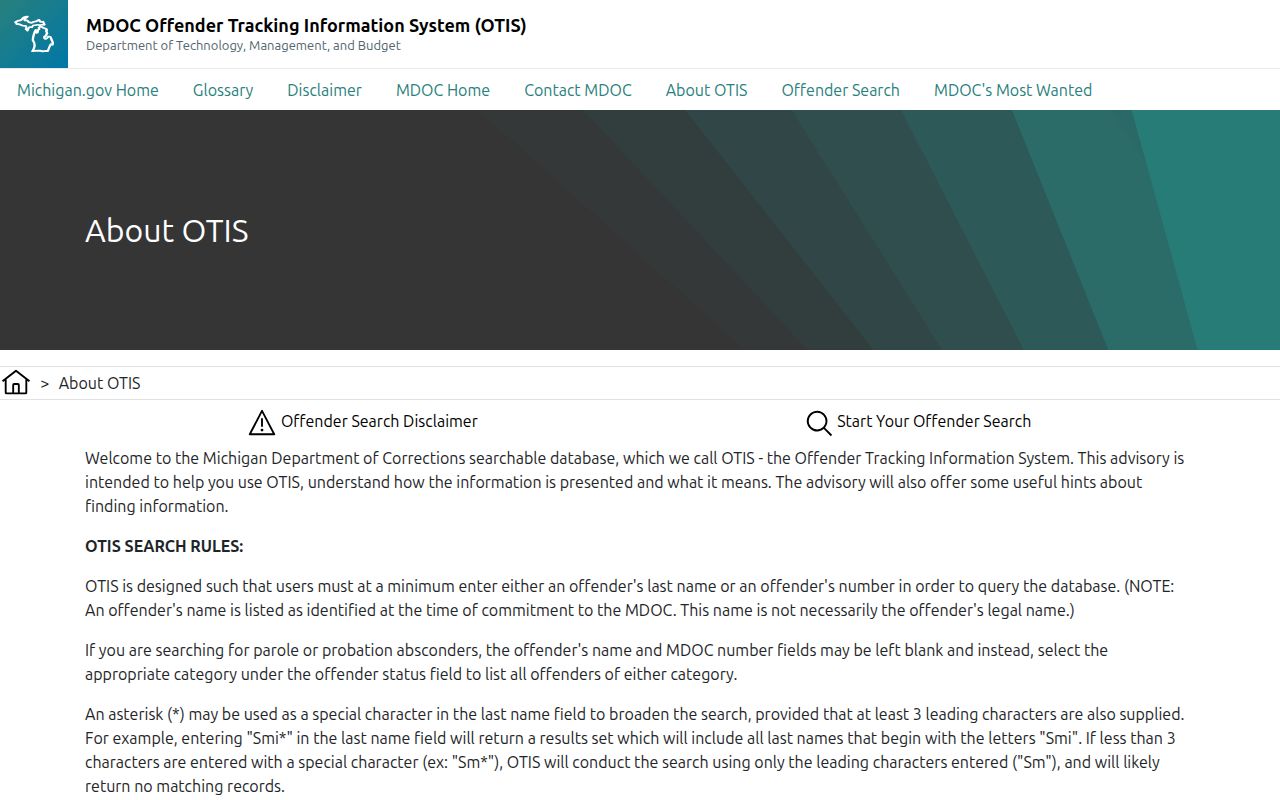
The glossary image supports reading the public field as an eligibility date, not turning it into an unsourced release countdown.
Michigan Truth-in-Sentencing Dates
Michigan does not use a universal rule that a prisoner serves about 85 percent. For covered truth-in-sentencing offenses, the prisoner generally must serve the full judicial minimum before the Parole Board obtains jurisdiction. MDOC identifies specified assaultive crimes committed on or after December 15, 1998, and other crimes committed on or after December 15, 2000. Covered prisoners do not shorten that minimum with good-time or disciplinary credits.
The offense date matters. The sentencing date alone cannot identify the credit framework. MCL chapter 800, including MCL 800.33 and 800.34, addresses older credit categories and disciplinary time. MCL chapter 791, including MCL 791.233, connects sentence categories to parole eligibility.
For eligible older sentences, good time, special good time, disciplinary credits, or disciplinary time may affect a date under the applicable law. Credits still do not compel parole. The Board may grant or deny release after jurisdiction begins, and institutional determinations can change credits available to a legacy sentence.
Note: Determine the offense-date cohort and read the judgment before applying any Michigan credit provision to an individual sentence.
Lake County Indeterminate Sentence Dates
Michigan felony sentences are commonly indeterminate. The court sets a minimum within legal limits, while the statutory framework supplies the maximum. The minimum opens the point at which the Board may act. It does not promise parole. The maximum marks the outer MDOC authority for that sentence after lawful computation, but another sentence or agency hold can still control what happens next.
Parole consideration generally begins before eligibility. A grant then moves to the Parole Release Unit for planning and processing. MDOC states that at least 28 days are required between the release decision and physical release. Misconduct or other adverse information may suspend the grant. That creates three separate events: eligibility, Board action, and actual departure.
Several active sentences require special care. One inactive sentence does not mean every term has ended. Concurrent terms run at the same time, while consecutive terms run one after another as the judgment and law require. An amended judgment, appeal, or resentencing can alter the structure after an earlier date was posted.
Lake County Jail Release Calculation
A Lake County jail-only sentence starts with the written judgment. It states the term and credit for days already served. The Lake County Jail custody ledger then records the local calculation and physical custody event. The statewide prison explanation cannot be copied onto a county sentence because OTIS is not the Lake County calculator.
Lake County has not published an official local good-time table, fixed release hour, or weekend and holiday acceleration rule. If a nominal completion falls on a weekend or holiday, call the jail at (231) 745-6201. Do not assume a Friday release. The same caution applies to property return, gate time, transport, or where a family member should wait.
A pre-sentence jail credit, corrected judgment, later court order, or another hold can change the practical result. For a dispute, compare the judgment with the custody ledger and ask the sentencing court or jail to explain the calculation. A court order may authorize release, but the jail record establishes when processing ended.
County date source: Use the Lake County judgment and jail ledger, not an OTIS percentage, for a jail-only sentence.
Why Lake County Release Dates Change
A release date can move because the law, sentence structure, Board action, conduct record, or another custody claim changes. Some factors alter the sentence calculation. Others leave the date intact but prevent release to the community. That distinction should remain clear in any Lake County date check.
| Factor | Effect on the date or release | Confirm with |
|---|---|---|
| Amended judgment or resentencing | Changes the court’s sentence or credit | Sentencing court and MDOC |
| Consecutive sentences | Moves the operative eligibility or maximum date | Judgment and OTIS sentence list |
| Legacy credits or disciplinary time | May change dates for an eligible older cohort | MDOC sentence computation |
| Parole grant, denial, or suspension | Changes whether departure follows eligibility | Michigan Parole Board and OTIS |
| County, federal, or ICE hold | May cause transfer instead of community release | Holding and receiving agencies |
| Appeal or new court order | May change legal authority for custody | Court register and written order |
A detainer is a request or notice that another authority wants custody. It may lead to a direct handoff. It should not be described as extra sentence time unless the controlling record says so. Preserve the source and date for each factor rather than combining them into one guessed release day.
Confirm Lake County Release Timing
Use the agency that owns the date. MDOC confirms its sentence and parole fields. The Lake County Jail confirms its local custody calculation. The sentencing court confirms the judgment and later orders. A VINELink notice may report a custody change from a participating agency, but it is not a permanent sentence record and it cannot rule out a transfer.
For a pending event, the Lake County VINELink check explains how to locate one record and register for offered notices. Preserve the alert’s exact wording and reporting agency. Then check OTIS, another jail, ICE, or the court if a transfer or hold is possible.
After departure, the strongest confirmation is the custody record with the actual release timestamp and disposition code. For MDOC parole, “Date Paroled” can identify prison exit. For a final state discharge, the discharge date and reason answer a later question. Each record is useful only for the event it was created to document.
When sources disagree, compare their scope and update time. A court may enter an order before Lake County staff finish processing. OTIS may show an eligibility date while the Board has not granted parole. A custody alert may arrive before a receiving system posts a transfer. Keep both entries, note when each was checked, and ask the agency that owns the disputed field. Choosing the earlier or later date without that check can turn two accurate but different events into one false release claim.
Note: Never convert an OTIS eligibility field into a promised pickup time or a fixed countdown.